Oops... we went to Jerusalem and Bethlehem before we took the road trip to North Camp... so this post is out of order! Sorry... but Blogger doesn't let you move posts, and I'd have to do the previous post all over again - no thanks!
It was an interesting day, but somewhat of a disappointment. We were assured that we could see the old city of Jerusalem even though it was Passover. What we didn't plan on was that it was also the Orthodox Easter. Unfortunately, when we got there, all the gates to the Christian parts of the old city were closed. We were told that the Albanians or Armenians (some dissident group, anyway) were causing trouble, so the only people the Israeli police were letting in were actual Christian worshipers who were citizens, and no tourists were allowed for safety reasons. So, the only part of the old city we got to actually enter was the Wailing Wall, where we were asked not to take photos...
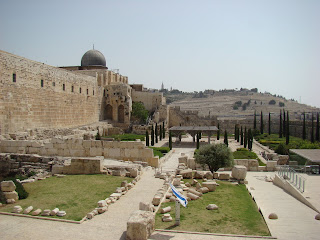
This is a view of the walls of the old city. The large dome you see is the Muslim Dome of the Rock.
Outside the walls was this Russian Orthodox church with its beautiful golden onion domes.

We're on a cliff overlooking the old city. Immediately below us are huge cemeteries of every denomination... Jewish, Christian and Muslim.

A gorgeous mural painted on one of the walls of the old city.

Not sure what this is, but it's a nifty garden just outside the entrance to the Wailing Wall.
These olive trees in the Garden of Gesthemane are descendants of the trees that were there in the time of Christ. Olive trees live up to 500-600 years and when the old part of the tree dies, it leaves new shoots to take its place. The girth of these old trees is amazing.
Another mural on the outside of the Church of All Nations, which is in the Garden of Gesthemane. This scene depicts Judas' kiss in the garden on the night of the Last Supper.

The church was built around the actual rock on which Jesus sat and contemplated the night before his capture by the Roman soldiers. You can see the rock, just in front of the altar.
Study this tree stump closely. Do you see the face of Jesus in the bark?

The walls of the old city as seen from the Garden of Gesthemane

And the gate through which Jesus was taken when he was captured.

This is the entrance to the part of Bethlehem that leads to the stable where Jesus was born. Bethlehem is located in Palestine, so we had to walk across a border checkpoint to get there.
This silver star in the floor of the cave marks the spot where Mary gave birth to Jesus, and the photo below it is the spot where the manger was located, about 8 feet away. Marble flooring, partitions, curtains and all kinds of things have been added to the site over the centuries. The walls and ceilings of the cave are black from the soot of candles that have burned constantly for hundreds of years. I don't know what I expected, but it wasn't all this gaudy stuff "decorating" these spots. I guess I thought the cave would have been more or less in its natural state, preserved - rather than embellished - over the centuries. 

This Orthodox church was built several centuries after the birth of Jesus, over the stable, which was actually a cave.

The colonnades of the monastery surrounding the church.
There is a hole in the present floor of the Orthodox church, which allows one to see what the original floor of the church looked like. Over the centuries, different cultures and conquerors added to and rebuilt portions of the church and monastery.

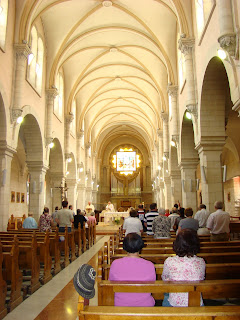
The Roman Catholic place of worship in the Bethlehem complex - obviously built much later than the Orthodox portion.
This catacombs is underneath the stable, which is underneath the churches, and the crypts contain the remains of many of the male babies that the emperor ordered to be killed when he heard the news of a newborn king.

 Leaving North Camp... from the height of the bus you get a better picture of what the North Camp entry/exit process is like.
 Believe it or not, the desert around El Gorah supports peach trees! Much to our surprise, we drove right through the peach harvest on market day!
 People with vehicles of all kinds, bringing their peaches to market in the little town of El Gorah.
 The open road again. Now we're heading toward the mountains, but we'll still be in the flatter desert for a couple of hours.
 The border fence... we were very close to it for much of the trip.
 This was my first view of the Gulf of Aqaba on the Red Sea. We were just north of the city of Taba here. You can see the coast of Jordan on the horizon. Later it becomes the coast of Saudi Arabia.


